Regenerative Biologic Technologies
Evidence-Based Adjuncts in Oral & Maxillofacial Surgery
Biologic therapies are at the forefront of regenerative medicine in oral and maxillofacial surgery. These therapies (Platelet-Rich Plasma (PRP), Platelet-Rich Fibrin (PRF), Bone Morphogenetic Protein (BMP-2), and Bone Marrow Aspirate Concentrate (BMAC)) harness your body's own cells and growth factors, or bioengineered proteins, to regenerate tissue, repair damage, and accelerate recovery after surgery.
Dr. Krajekian integrates these regenerative approaches with cutting-edge digital surgical planning, VR-guided surgery, and custom 3D-printed hardware, achieving better outcomes with faster healing, reduced complications, and less discomfort.
Platelet-Rich Plasma (PRP)
Autologous growth factor concentrate
PRP is a plasma fraction derived from your own blood that contains a platelet concentration 2–5× higher than normal. Platelets contain alpha-granules that release biologically active growth factors (including PDGF, TGF‑β, VEGF, EGF, FGF, and IGF‑1) which enhance the early phases of wound healing.
How It Works: Step by Step
- 1.Simple Blood Draw
A small amount of blood is drawn from your arm, similar to a routine blood test
- 2.Centrifuge Separation
Your blood is spun in the centrifuge to separate the platelet-rich layer from red blood cells (~10–15 minutes)
- 3.Platelet Concentration
The golden, platelet-rich layer is collected, containing concentrated growth factors (PDGF, TGF‑β, VEGF, EGF, FGF, IGF‑1)
- 4.Applied to Surgical Site
The concentrated PRP is applied directly to the wound, stimulating angiogenesis, fibroblast proliferation, and collagen synthesis
Clinical Applications
Evidence: PRP demonstrates consistent benefit for soft tissue healing and early wound maturation. Evidence for significant bone volume enhancement alone is mixed. It is best used as an adjunct alongside graft material.

Platelet-Rich Fibrin (PRF)
Second-generation platelet concentrate
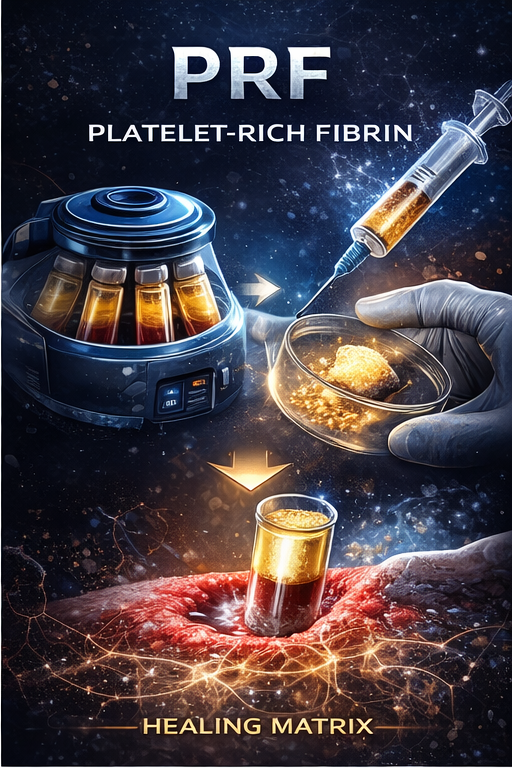
PRF is a second-generation autologous platelet concentrate produced without anticoagulants, resulting in a natural fibrin matrix scaffold that entraps platelets and leukocytes. Unlike PRP, it forms a solid biologic membrane, think of it as a living bandage made entirely from your own blood that slowly releases growth factors over 7–14 days.
What Makes PRF Different from PRP
How It Works: Step by Step
- 1.Blood Draw
A small amount of blood is drawn from your arm. No additives or chemicals are used
- 2.Slow Centrifuge Spin
The blood is spun at a slower speed than PRP, allowing a natural fibrin matrix to form through slow polymerization
- 3.Fibrin Scaffold Forms
The result is a golden, gel-like membrane packed with platelets, growth factors, cytokines, and white blood cells, all trapped in a natural fibrin mesh
- 4.Placed at Surgical Site
The PRF membrane is placed at the surgical site where it functions as a biologic scaffold, growth factor matrix, and soft tissue stabilization membrane
Clinical Applications
Evidence: Strong evidence for soft tissue maturation and graft stabilization. Moderate evidence for improved bone quality when combined with graft material. Preparation is chairside with centrifuge.
BMP-2 (Bone Morphogenetic Protein-2)
Recombinant osteoinductive cytokine
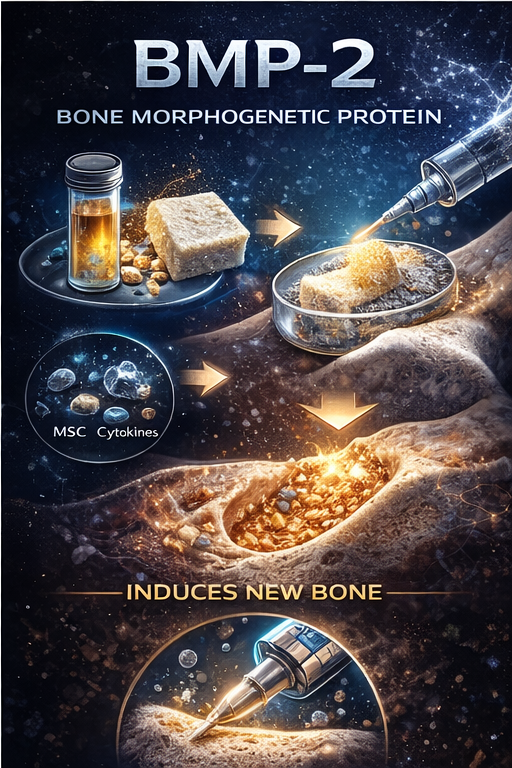
Recombinant human BMP-2 (rhBMP-2) is a bioengineered osteoinductive cytokine that stimulates mesenchymal stem cells to differentiate into osteoblasts (the cells that build new bone. Unlike PRP and PRF which are supportive, BMP-2 actively signals bone formation. It is delivered on an absorbable collagen sponge carrier system and is not autologous (not from your own body).
How It Works: Step by Step
- 1.Protein Placement
BMP-2 is placed at the surgical site on an absorbable collagen sponge, a soft, dissolvable carrier that holds the protein in place
- 2.Stem Cell Recruitment
BMP-2 releases signals that recruit mesenchymal stem cells from surrounding tissue to the area
- 3.Osteoblastic Differentiation
The stem cells respond to BMP-2's signals by differentiating into osteoblasts (bone-forming cells)
- 4.De Novo Bone Formation
Osteoblasts produce new, living bone that integrates naturally with existing anatomy, a permanent, biologic result
Clinical Applications
Important Considerations: FDA-approved for specific indications. Off-label use requires proper consent. Associated with dose-dependent swelling. Must be used cautiously in confined spaces.
Evidence: Strong evidence for bone formation in approved indications. Higher biologic potency than PRP/PRF. BMP-2 is fundamentally different from PRP/PRF. It is osteoinductive, meaning it actively signals bone formation rather than just supporting the healing process.
Bone Marrow Aspirate Concentrate (BMAC)
Autologous stem cell concentrate
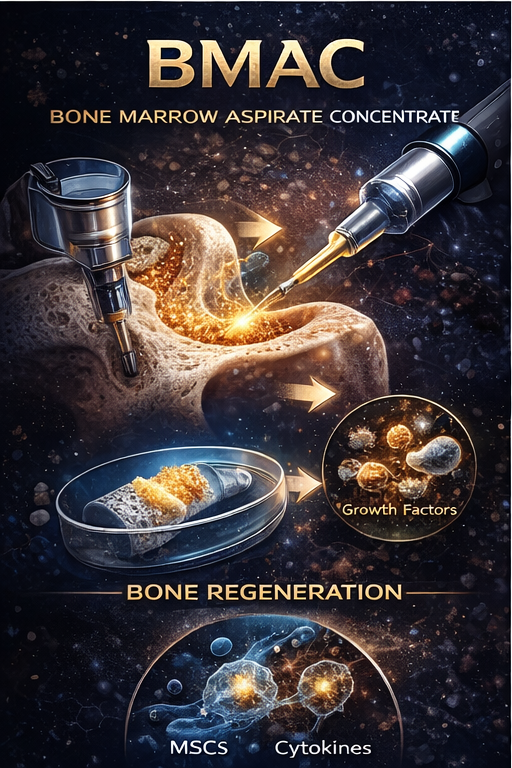
BMAC is an autologous concentrate derived from aspirated bone marrow (commonly the anterior iliac crest). Unlike PRP and PRF which primarily deliver growth factors, BMAC is a cell-based therapy. It contains mesenchymal stem cells, hematopoietic stem cells, progenitor cells, cytokines, and growth factors. It provides osteogenic cells, osteoinductive signals, and osteoconductive support when combined with graft matrix.
How It Works: Step by Step
- 1.Bone Marrow Aspiration
A sample of bone marrow is drawn from the anterior iliac crest (hip) using a needle under anesthesia
- 2.Centrifuge Processing
The bone marrow sample is placed in a centrifuge, which concentrates the mesenchymal stem cells, hematopoietic stem cells, and progenitor cells
- 3.Stem Cell Concentration
The result is a concentrated solution packed with your own stem cells, providing osteogenic cells that can form new bone, not just growth factors
- 4.Application to Surgical Site
The concentrate is combined with graft matrix and applied to the reconstruction site, enhancing biologic vitality of the graft
Clinical Applications
Evidence: Evidence supports improved graft integration in complex reconstruction. Higher complexity than PRP/PRF. Less commonly office-based due to aspiration site, sterility, and patient comfort considerations.
Side-by-side comparison of all four regenerative biologic technologies
| Therapy | Biological Type | Source | Primary Function | Osteoinductive? | Cell-Based? | Setting | Best Used For |
|---|---|---|---|---|---|---|---|
| PRP | Growth factor concentrate | Peripheral blood | Enhances early healing | No | No | Office / OR | Soft tissue & adjunctive grafting |
| PRF | Fibrin matrix + growth factors | Peripheral blood | Scaffold + sustained release | No | No | Office / OR | Graft stabilization & soft tissue |
| BMP-2 | Recombinant cytokine | Bioengineered protein | Induces bone formation | Yes | No | Office / OR | Large defects & reconstruction |
| BMAC | Stem cell concentrate | Bone marrow | Provides osteogenic cells | Yes (indirect) | Yes | Primarily OR | Complex reconstruction |
Clinical Complexity Hierarchy
PRP
Low Complexity
PRF
Moderate Complexity
BMP-2
High Biologic Induction
BMAC
Advanced Cellular Therapy
Real Patient Success: Stem Cell Bone Regeneration
A patient had 80% of their jaw destroyed by a cyst. Dr. Krajekian removed the damaged section, placed plates and mesh, and harvested stem cells from the patient's hip to regenerate the lower jaw bone.
1 Night
Hospital Stay
2 Weeks
Back to Work
No Wiring
Required