TMD / TMJ Disorders & Surgery
What is TMD?
Temporomandibular Disorders (TMD) is an umbrella term for a group of conditions affecting the temporomandibular joint (TMJ), the muscles of mastication (chewing), and associated structures. While many people use "TMJ" colloquially, TMJ refers to the joint itself and TMD refers to the disorders that affect it.
TMD is estimated to affect 5–12% of the general population, with over 10 million Americans impacted. It is significantly more common in women, particularly those of reproductive age, due to hormonal influences on the joint. However, only about 2% of those affected seek medical treatment.
The pathophysiology of TMD may result from muscular hyperfunction or parafunction (such as clenching and grinding) and/or underlying degenerative changes within the joint. TMD is divided into two basic categories: nonarticular joint disease (muscle-related) and articular joint disease (joint-related). Treatment should be multifactorial with a multidisciplinary approach. Failure to do so can result in incomplete treatment that does not fully resolve patient symptoms.
Understanding your TMJ anatomy is the first step toward treatment. Click to watch educational animations.
Animations adopted from TMJ.com with permission
Key Facts
- •Affects 10+ million Americans
- •More common in women (2-3x)
- •Most cases respond to conservative care
- •Headaches are a leading symptom
- •Early treatment improves outcomes
- •Multidisciplinary approach essential
- •VR-guided surgical planning
- •Custom 3D-printed titanium prostheses
- •FDA special approval for each device
When to Seek Treatment
- •Persistent jaw pain lasting more than a few days
- •Chronic headaches not responding to treatment
- •Jaw locking open or closed
- •Difficulty opening your mouth fully
- •Progressive worsening of symptoms
Recovery Time
Varies by procedure: Arthrocentesis (1-2 days), Arthroscopy (1-2 weeks), Total Joint Replacement (2-4 weeks initial; 3-6 months full recovery)
Could You Have a TMJ Disorder?
Take this quick self-assessment to evaluate your symptoms and learn whether a professional TMJ evaluation may be right for you.
Could You Have a TMJ Disorder?
Take this quick 10-question screening, results in under 2 minutes
Common TMD Symptoms
TMD can manifest in many ways. If you experience any of these symptoms, early evaluation and treatment can prevent progression.
Jaw pain or tenderness
Aching pain in the jaw joint area, face, or around the ear
Clicking, popping, or grating
Sounds or sensations when opening or closing the mouth
Difficulty chewing
Pain or discomfort while chewing, or a sudden uncomfortable bite
Jaw locking
Difficulty opening or closing the mouth (open or closed lock)
Headaches & migraines
Chronic headaches, tension headaches, or migraine episodes triggered by TMD
Ear symptoms
Ear pain, fullness, ringing (tinnitus), or a feeling of congestion
Facial muscle fatigue
Tired feeling in the face, especially after chewing or speaking
Neck & shoulder pain
Referred pain extending from the jaw to the neck and shoulders
TMD, Headaches & Migraines
TMD is one of the most underdiagnosed causes of chronic headaches and migraines
How TMD Causes Headaches
The muscles of mastication (particularly the temporalis and masseter) can refer pain directly to the temples, forehead, and behind the eyes. When these muscles are chronically tense from clenching, grinding, or TMJ dysfunction, they create persistent tension-type headaches that may be misdiagnosed as primary headaches.
- •Temporalis muscle pain refers to temples and forehead
- •Masseter dysfunction causes cheek and jaw pain
- •Lateral pterygoid issues cause deep facial and ear pain
TMD & Migraine Connection
Research shows that TMD and migraines share common neurological pathways. The trigeminal nerve (which innervates both the TMJ and is the primary nerve involved in migraines) creates a direct link between jaw dysfunction and migraine episodes. Treating TMD can significantly reduce migraine frequency and severity.
- •Shared trigeminal nerve pathway
- •TMJ inflammation can trigger migraine cascade
- •Botox treats both TMD and chronic migraines
Tension-Type Headaches
Chronic muscle tension from clenching and grinding causes bilateral, pressing headaches that wrap around the head. Often worse in the morning or late afternoon.
Migraine Triggers
TMJ inflammation and muscle dysfunction can activate the trigeminal nerve, triggering full migraine episodes with aura, nausea, light sensitivity, and throbbing pain.
Referred Pain Patterns
TMD muscles refer pain to the temples, behind the eyes, the forehead, and even down the neck. This is why many patients see multiple doctors before TMD is identified.
TMD Classification
TMD is classified into three main categories based on the affected structures
The most common form of TMD. Involves pain and dysfunction in the muscles that control jaw movement.
- •Muscle pain and spasm
- •Myofascial pain syndrome with trigger points
- •Fibromyalgia-related TMD
- •Tension headaches from muscle dysfunction
- •Bruxism-related muscle fatigue
Involves displacement or damage to the articular disc that cushions the TMJ during movement.
- •Disc displacement with reduction (clicking)
- •Disc displacement without reduction (locking)
- •Inflammation of the joint space (synovitis)
- •Disc perforation
- •Adhesions restricting disc movement
Involves structural changes to the bony components of the TMJ, often progressive in nature.
- •Primary osteoarthritis (degenerative)
- •Rheumatoid arthritis (autoimmune)
- •Ankylosis (joint fusion)
- •Condylar hyperplasia (overgrowth)
- •Trauma-related degeneration
A five-stage system classifying the progression of TMJ internal derangement, guiding treatment decisions from conservative to surgical.
Stage I: Early
Painless clicking, no significant limitation of movement. Disc slightly displaced but reduces on opening.
Stage II: Early/Intermediate
Occasional painful clicking, intermittent locking. Early disc deformity with mild displacement.
Stage III: Intermediate
Frequent pain, joint tenderness, headaches. Significant disc displacement with possible locking episodes.
Stage IV: Intermediate/Late
Chronic pain, limited motion, headaches. Significant disc displacement with degenerative changes beginning.
Stage V: Late
Variable pain, crepitus (grinding sounds), chronic limited motion. Disc perforation, severe degenerative arthritis, bone-on-bone changes.
Systemic Connections
TMD often coexists with other conditions. Understanding these connections is essential for comprehensive treatment.
Fibromyalgia
Central sensitization in fibromyalgia amplifies TMD pain. Up to 75% of fibromyalgia patients report TMJ symptoms. Coordinated treatment addressing both conditions yields better outcomes.
Autoimmune Diseases
Rheumatoid arthritis, lupus, scleroderma, and psoriatic arthritis can directly affect the TMJ. Dr. Krajekian coordinates with rheumatology for comprehensive management.
Hormonal Influences
Estrogen receptors in the TMJ contribute to higher prevalence in women. Hormonal fluctuations can worsen symptoms. Understanding these factors guides treatment timing.
Sleep Disorders
Sleep bruxism and sleep apnea are closely linked to TMD. Poor sleep quality worsens pain perception. Addressing sleep is a critical part of TMD treatment.
Conservative Treatments
Most TMD patients respond well to non-surgical treatment. We exhaust all conservative options before considering surgery.
Treatment Philosophy
Dr. Krajekian follows an evidence-based, conservative-first approach: Understand → Diagnose → Treat conservatively → Surgery only when necessary. Treatment recommendations are based on high-quality evidence including randomized controlled trials, transparent success rates, and continuous learning from emerging research.
Surgical Treatment Options
When conservative measures are insufficient, Dr. Krajekian offers the full spectrum of TMJ surgical options, from minimally invasive to total joint replacement.
Dr. Krajekian offers both custom 3D-printed and stock TMJ prostheses. Both options use FDA-approved titanium alloys and are planned with VR surgical rehearsal for precision. Dr. Krajekian will recommend the best option for you based on your anatomy, condition, and treatment plan.
| Feature | Custom 3D-Printed | Stock Prosthesis |
|---|---|---|
| Design | Precisely matched to your anatomy using CT scan data | Proven standardized design that fits a wide range of patients |
| VR Planning | Full VR surgical rehearsal | Full VR surgical rehearsal |
| Materials | FDA-approved titanium alloys | FDA-approved titanium alloys |
| Turnaround | Requires manufacturing lead time for fabrication | Available for faster scheduling when clinically appropriate |
| Ideal For | Complex anatomy, revision cases, unique structural needs | Standard replacement cases with favorable anatomy |
| Dr. Krajekian's Approach | Recommended when anatomy or prior surgery demands a patient-specific solution | Recommended when it provides the best clinical outcome for your case |
Both options deliver excellent long-term outcomes. Dr. Krajekian will discuss which prosthesis is right for you during your consultation.
Treatment Animation Videos
Click to watch animations explaining each treatment option
Animations adopted from TMJ.com with permission
VR-Guided TMJ Surgery
Dr. Krajekian utilizes world-first Virtual Reality technology for TMJ surgical planning
Virtual Reality Guided Surgical Planning
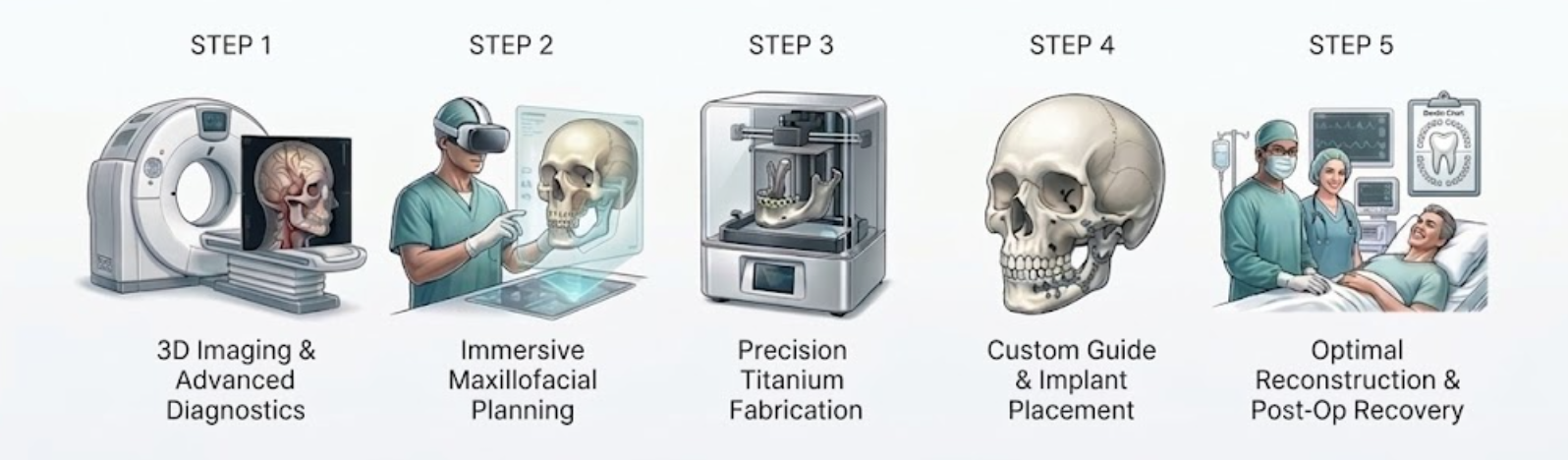
3D Imaging
High-resolution CBCT and MRI scans
Virtual Analysis
Joint examined in 3D environment
Surgical Simulation
Procedure rehearsed virtually
Prosthesis Design
Custom implants designed
VR-Guided Surgery
Precision execution from virtual rehearsal
TMD Disease Staging & Treatment Mindmap
A comprehensive visual guide to understanding TMD progression and treatment pathways
Dr. Krajekian utilizes the Wilkes staging system combined with advanced imaging to determine the most appropriate treatment pathway. Each patient receives a personalized treatment plan based on their specific disease stage and individual needs.
Dr. Krajekian's Advanced Approach
TMJ surgery has evolved dramatically. Dr. Krajekian combines VR planning, piezoelectric precision, and regenerative biologics to achieve safer, more predictable outcomes for complex joint reconstruction.
VR Surgical Rehearsal
Every TMJ surgery is planned and rehearsed in Virtual Reality (Surgical Rehearsal™), allowing Dr. Krajekian to visualize the joint anatomy in 3D and practice the procedure before the first incision, ensuring millimeter-level accuracy.
Piezoelectric Surgery
Ultrasonic piezoelectric instruments make precise bone cuts around the delicate TMJ structures while preserving the facial nerve, blood vessels, and surrounding soft tissue, significantly reducing swelling and recovery time.
Biologics for Healing
Platelet-Rich Fibrin (PRF) and Bone Marrow Aspirate Concentrate (BMAC) are applied at the surgical site to accelerate bone integration with custom prostheses and promote soft tissue healing, using the patient's own biology.
FDA-Approved Custom Prostheses
One of the only surgeons worldwide performing custom 3D pure titanium TMJ joint replacement with individual FDA special approval for each patient-specific device, designed to match your exact anatomy.
Cleveland Clinic Collaboration
Dr. Krajekian co-founded a multidisciplinary TMJ management team at Cleveland Clinic, integrating oral surgery, rheumatology, physical therapy, and pain management for comprehensive patient care.
World's First VR TMJ Replacement
Performed the world's first TMJ joint replacement using Virtual Reality, pioneering the use of Surgical Rehearsal™ for unprecedented precision in complex joint reconstruction.
Conservative-First Philosophy
Surgery is always the last option. Dr. Krajekian exhausts all conservative treatments (splints, physical therapy, Botox, arthrocentesis) before recommending surgical intervention.
Take the First Step Toward Relief
Whether you're dealing with chronic jaw pain, headaches, or difficulty opening your mouth, Dr. Krajekian can help you find the right treatment path.