Orthognathic (Jaw) Surgery
Orthognathic surgery corrects irregularities of the jaw bones to improve function, aesthetics, and quality of life. Dr. Krajekian uses the most advanced Virtual Surgical Planning (VSP) technology available to achieve precise, predictable results.
Understanding Jaw Discrepancies
Orthognathic surgery addresses:
Skeletal Problems
- •Underbite (mandibular prognathism)
- •Overbite (mandibular retrognathia)
- •Open bite
- •Facial asymmetry
- •Long face syndrome
Functional Issues
- •Difficulty chewing or biting
- •Speech problems
- •Chronic jaw pain
- •Sleep apnea
- •TMJ disorders
Virtual Surgical Planning (VSP) Workflow
Traditional Approach (Pre-VSP Era)
- 1.Physical stone models of teeth
- 2.Manual measurements and calculations
- 3.Hand-cut surgical splints
- 4.Limited visualization of bone movements
- 5.Less predictable outcomes
Modern VSP Approach
- 1.3D CBCT and facial scanning
- 2.Computer-aided surgical simulation
- 3.VR visualization and planning
- 4.3D-printed custom surgical guides
- 5.Highly predictable, precise outcomes
The VSP Process
Step 1: Imaging
High-resolution 3D imaging captures your complete jaw and facial anatomy.
Step 2: Virtual Planning Session
Dr. Krajekian collaborates with biomedical engineers in a VR environment to plan every millimeter of bone movement.
Step 3: Surgical Simulation
The entire procedure is virtually rehearsed, identifying optimal osteotomy locations and movements.
Step 4: Custom Hardware Design
3D-printed surgical guides, splints, and sometimes custom plates are manufactured specifically for your surgery.
Step 5: Precise Execution
Custom guides ensure surgical movements match the virtual plan exactly.
Types of Orthognathic Procedures
Le Fort I Osteotomy (Upper Jaw)
- •Corrects maxillary discrepancies
- •Can be moved up, down, forward, or rotated
- •Often combined with lower jaw surgery
Bilateral Sagittal Split Osteotomy (Lower Jaw)
- •Most common mandibular procedure
- •Advances or sets back the lower jaw
- •Corrects asymmetry
Genioplasty (Chin Surgery)
- •Advances, sets back, or reshapes the chin
- •Can be performed alone or with jaw surgery
- •Significant aesthetic improvement
Bimaxillary Surgery (Both Jaws)
- •Simultaneously corrects upper and lower jaw
- •Most comprehensive correction
- •Used for severe discrepancies
Custom 3D-Printed Hardware
Dr. Krajekian utilizes VSP technology to design:
- •Custom cutting guides ensure osteotomies are made at planned locations
- •Custom positioning splints guide precise jaw positioning
- •Custom titanium plates pre-bent to final bone position
- •Custom screws with optimal length predetermined by virtual planning
Post-Operative Care
Hospital Stay (1–2 Nights)
- •IV fluids and pain medication
- •Anti-swelling medications
- •Jaw exercises begin day 1
- •Liquid diet through syringe
Weeks 1–2
- •Significant swelling peaks days 2–3, then decreases
- •Ice packs 20 min on/off while awake
- •Liquid diet only (protein shakes, smoothies, broths)
- •Sleep with head elevated (2–3 pillows)
- •Prescribed oral hygiene routine
Weeks 2–6
- •Soft diet begins (scrambled eggs, pasta, mashed foods)
- •Swelling continues to decrease
- •Begin jaw exercises as directed
- •Follow-up X-rays and appointments
- •May return to school or work at 2–3 weeks
Months 2–3
- •Transition to regular diet as tolerated
- •Avoid hard, chewy, or crunchy foods
- •Continued jaw exercises
- •Final bite settling
Months 3–12
- •Orthodontic fine-tuning if needed
- •Progressive return to all activities
- •Bone fully healed by 6–12 weeks
- •Final results visible at 6–12 months
Key Benefits
- •VSP with 3D-printed custom guides
- •VR surgical planning and rehearsal
- •Enhanced surgical precision
- •Predictable aesthetic outcomes
- •Improved bite function
- •Better breathing and sleep
Recovery Time
2 weeks soft diet; 6-12 weeks full recovery
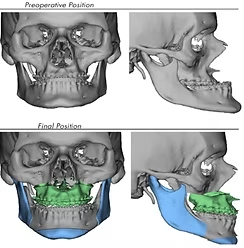
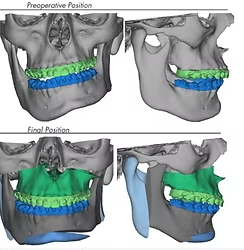
Virtual Surgical Planning: preoperative analysis and planned final jaw position with 3D-printed guides
Understanding Orthognathic Surgery
Watch this educational overview of corrective jaw surgery, including the planning process, surgical techniques, and expected outcomes.
Corrective Jaw Surgery: Procedure Overview
A comprehensive look at how orthognathic surgery corrects jaw discrepancies to improve function, aesthetics, and quality of life
Dr. Krajekian's Advanced Approach
Modern orthognathic surgery has evolved dramatically. Patients recover faster, experience less discomfort, and achieve more predictable results than ever before.
Jaws Rarely Wired Shut
Modern fixation techniques using titanium plates and screws provide rigid stability, eliminating the need for jaw wiring in the vast majority of cases. Patients can open their mouth and speak shortly after surgery.
Piezoelectric Surgery
Ultrasonic piezoelectric instruments make precise bone cuts while preserving nerves, blood vessels, and soft tissue. This results in less swelling, reduced nerve injury risk, and faster recovery compared to traditional rotary saws.
Biologics for Enhanced Healing
Dr. Krajekian utilizes advanced biologics including Platelet-Rich Fibrin (PRF) and Bone Marrow Aspirate Concentrate (BMAC) at the osteotomy sites to accelerate bone healing, reduce swelling, and promote faster recovery.
VR Surgical Rehearsal
Every case is planned in Virtual Reality with 3D-printed custom guides and splints for millimeter-level accuracy. Dr. Krajekian rehearses the entire surgery in VR before the first incision.
Role of Biologics in Orthognathic Surgery
Biologics are naturally derived growth factors and scaffolds that enhance the body's healing response at surgical sites. In orthognathic surgery, they are applied directly to the osteotomy (bone cut) sites to promote rapid bone regeneration and reduce complications.
Platelet-Rich Fibrin (PRF)
Derived from the patient's own blood, PRF concentrates growth factors and white blood cells into a fibrin membrane. It accelerates soft tissue healing, reduces inflammation, and enhances bone regeneration with zero risk of rejection.
Bone Marrow Aspirate Concentrate (BMAC)
Harvested from the patient's own bone marrow, BMAC is rich in mesenchymal stem cells, growth factors, and cytokines that directly stimulate bone regeneration at osteotomy sites. Applied at the surgical site, it accelerates bone union and enhances healing, all using the patient's own biology with no risk of rejection.
Piezoelectric Surgery: Precision Bone Cutting
Piezoelectric surgery uses ultrasonic vibrations to cut bone with extreme precision while leaving adjacent soft tissues (nerves, blood vessels, and membranes) completely unharmed. This selectivity is impossible with traditional rotary instruments.
How It Works
Piezoelectric devices generate ultrasonic micro-vibrations (25–30 kHz) that cut mineralized bone tissue while stopping at soft tissue contact. The frequency is calibrated to only affect hard structures, providing a level of tissue selectivity that traditional saws cannot achieve.
Clinical Advantages
- •Significantly reduced risk of inferior alveolar nerve injury
- •Less post-operative swelling and edema
- •Cleaner osteotomy lines promote faster bone healing
- •Improved surgical precision in confined anatomical spaces
Vercellotti, Int J Periodontics Restorative Dent 2004; Beziat et al., Rev Stomatol Chir Maxillofac 2007
Patient Satisfaction & Outcomes
Published peer-reviewed data demonstrates high satisfaction and quality-of-life improvements following orthognathic surgery
Patient Satisfaction
Report satisfaction with facial appearance and function
Pachêco-Pereira et al., JOMS 2016
Functional Improvement
Significant improvement in chewing ability
Alanko et al., Int J Oral Maxillofac Surg 2010
Would Have Surgery Again
Patients who would undergo the procedure again
Esperão et al., JOMS 2010
Quality of Life Gain
Report improved overall quality of life
Murphy et al., JOMS 2011
Modern Recovery Timeline
Able to open mouth, speak, and drink liquids
Soft diet; most swelling resolves; return to light activity
Transition to softer solid foods; significant swelling reduction
Most patients return to normal diet and full activity
Complete bone healing; final occlusion settled; orthodontic finishing
Why VSP + VR Changes Everything
- •Sub-millimeter surgical accuracy with 3D-printed custom guides
- •Shorter operative time due to pre-planned approach
- •Reduced blood loss and faster recovery
- •Predictable aesthetic and functional outcomes
- •Custom titanium plates for precise bone fixation
- •Virtual reality rehearsal eliminates surgical surprises
- •Piezoelectric bone cutting preserves nerves and soft tissue
- •Biologics (PRF, BMAC) applied at osteotomy sites for faster bone healing
Advanced & Complex Implant Placement: VR-Guided Planning & Rehearsal
VR-guided surgical rehearsal for precise, predictable implant placement
Explore Other Procedures
Have Questions About Orthognathic (Jaw) Surgery?
Schedule a consultation to discuss if this procedure is right for you